

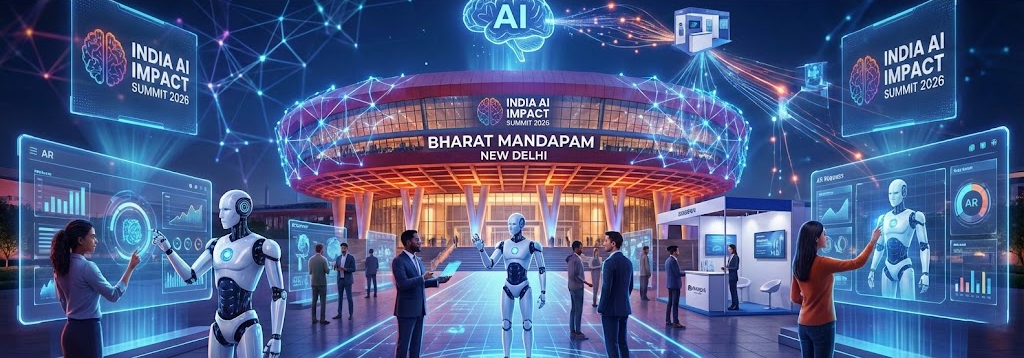
Translating the Future: How AI is Rewiring Experiential Marketing and Brand Engagement
Reflections from the India AI Impact Summit 2026, Bharat Mandapam
The India AI Impact Summit 2026 at Bharat Mandapam was a defining moment for the global tech industry. Drawing over 2.5 lakh visitors and showcasing over 300 exhibitors, the conversation decisively shifted from “vision” to “deployment.” We saw everything from indigenous foundational models to physical humanoid robots interacting on the expo floor.
For agencies specializing in experiential marketing, exhibitions, retail branding, and digital engagement, the challenge is clear: how do we market the invisible and make the futuristic tangible? By looking at the actual innovations showcased in New Delhi, we can map out the future of brand engagement.
1. Exhibitions: Creating “Phygital” Demo Zones for Industrial Robotics
The Innovation: The summit floor was dominated by hardware. Addverb unveiled Elixis-W, a completely made-in-India humanoid robot designed for manufacturing, while Alphadroid showcased CarryMate, an autonomous logistics robot built for hospitality and retail. The Agency Application: You cannot simply place a highly advanced, autonomous machine on a static pedestal. Exhibition design must evolve into live, simulated environments. To market these innovations, agencies must build interactive “phygital” (physical + digital) arenas where B2B delegates can actively trigger logistics scenarios, step into the robot’s path to test collision avoidance, or use AR-enabled screens to “see” the AI’s real-time spatial mapping overlaid on the physical robot.
2. Experiential Marketing: Architecting the “Day in the Life” Pavilion
The Innovation: The Jio Intelligence Pavilion was a massive draw, showcasing an interconnected ecosystem that included Jio Sanskriti AI (cultural preservation), Jio Shiksha (education), and Jio AI Home (smart living). The Agency Application: Experiential marketing must move from isolated product stands to immersive, narrative-driven walkthroughs. To showcase a connected ecosystem, agencies can design multi-sensory tunnels. As delegates walk from one zone to the next, smart sensors seamlessly transition the lighting, soundscape, and digital backdrops—from a bustling, AI-assisted classroom to an automated living room. It allows the audience to physically walk through the AI’s impact on daily life.
3. Retail Branding: Interactive Zones for Consumer Wearables
The Innovation: AI is becoming highly personal. Sarvam AI introduced Sarvam Kaze, India’s first AI-powered glasses, and Miko showcased its AI-powered companion robot for children. The Agency Application: Retail branding for AI consumer products requires zero-friction experience zones. Instead of locking products in glass display cases, retail spaces must feature integrated smart mirrors and live-feed kiosks. Customers trying on AI glasses in a retail store should immediately see real-time translations or data overlays projected onto the retail environment itself, turning the physical store into a live canvas for the product’s capabilities.
4. Digital Marketing: Hyper-Personalization via Voice Cloning
The Innovation: Gnani.ai demonstrated Vachana TTS, a text-to-speech system capable of cloning a human voice with less than 10 seconds of audio, flawlessly preserving regional pitch, tone, and speaking style. The Agency Application: Digital marketing is stepping beyond generic mass emails and rigid translations. Agencies can leverage this technology to run hyper-localized digital campaigns where a brand ambassador or CEO “personally” addresses the viewer in their exact native regional language and dialect. The digital engagement shifts from broadcast messaging to authentic, emotional storytelling at an unprecedented, automated scale.
5. Gifting & Merchandising: Sustainable and Purpose-Driven Curation
The Innovation: The summit placed a heavy emphasis on environmental impact (the “Planet” pillar), highlighted by companies like Mankomb, who showcased Chewie, an AI system designed for sustainable waste management. Corporate merchandising must align with these new, tech-driven sustainability values. Agencies can use AI trend-forecasting to design highly curated, eco-conscious gifting kits that resonate with a recipient’s professional footprint. The merchandise becomes a strategic, premium extension of a brand’s commitment to innovation and the planet, rather than a disposable token.
The Road Ahead
The AI Impact Summit 2026 proved that technology is only as powerful as the human experience it enables. The foundational models and the hardware are here; the next frontier is building the physical and digital stages where these technologies can truly connect with human audiences.
Leave a comment: